Seattle Jobs Report: Health Care and Manufacturing Grow While Finance, Tech and Government Shrink
SEATTLE, WA — The September jobs numbers for the Seattle area tell two stories at once. The unemployment rate barely moved, but the mix of who is hiring keeps shifting away from the office towers of South Lake Union and the downtown core and toward hospitals, factory floors and job sites. For anyone job hunting between Everett and Tacoma this fall, that shift matters more than the headline rate.
Health care and manufacturing are growing in the Seattle metro. Finance, government and tech are shrinking. Here is what the latest state and federal data show, and where to point your search.
Need work now? Skip straight to the job links for the sectors that are adding workers →
The Seattle Unemployment Rate in September 2026
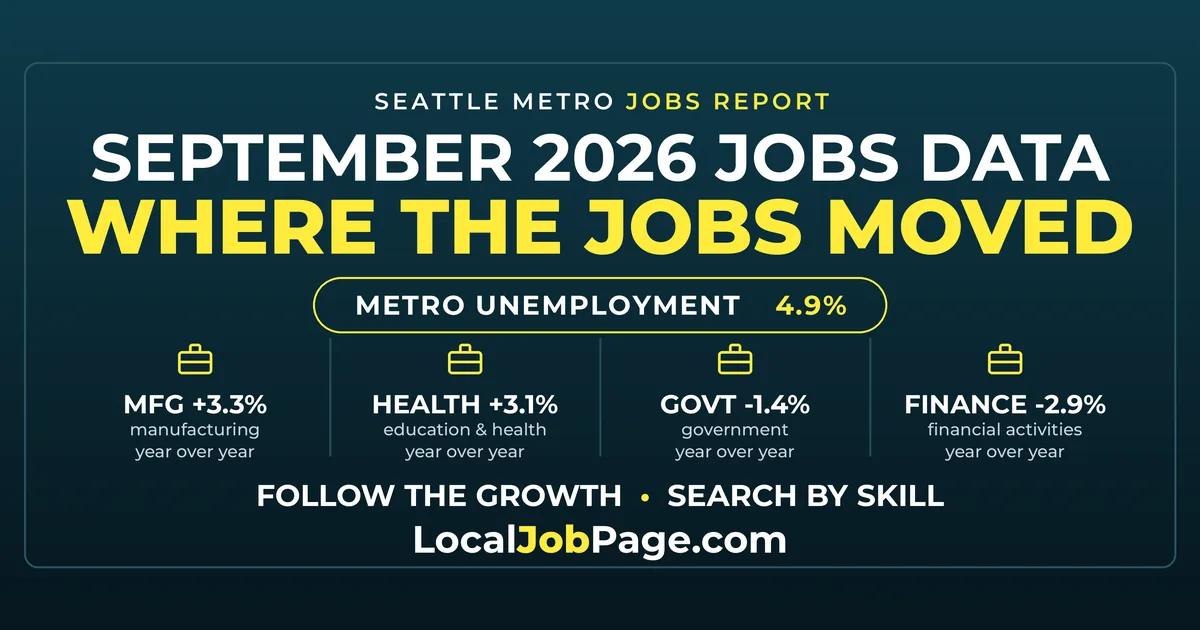
According to the U.S. Bureau of Labor Statistics, the Seattle-Tacoma-Bellevue metro, which covers King, Snohomish and Pierce counties, posted a preliminary 4.9% unemployment rate in September, up from 4.8% in August. That figure is not seasonally adjusted.
Statewide, the Washington Employment Security Department reported a seasonally adjusted 4.8% rate, the third monthly decline in a row. That good news comes with a catch. The state also estimated it lost 15,400 jobs in September, and its labor force has been shrinking. ESD notes that when people stop looking for work for more than four weeks, they drop out of the unemployment count entirely.
Where Seattle-Area Jobs Are Growing
The federal data compare September 2026 with a year earlier, and a few sectors stand out across the three counties:
- Manufacturing: up 3.3%. The fastest-growing sector in the metro over the past year.
- Education and health services: up 3.1%. This is the group that includes hospitals, clinics and long-term care.
- Construction and leisure and hospitality: each up 1.1%.
- Trade, transportation and utilities, plus professional and business services: each up 0.7%.
Total nonfarm employment in the metro stood at about 2,141,500 jobs in September, up 0.7% from a year earlier.
Where Jobs Are Shrinking
On the other side of the ledger, financial activities fell 2.9% over the year in the Seattle metro, government fell 1.4%, and the information sector, which includes much of the region's tech work, slipped 0.8%. Statewide, government shed an estimated 10,400 jobs in September alone, the largest drop of any sector.
Reporting by Axios Seattle found the city's unemployment rate has matched or topped the statewide rate every month since September 2025, after years of running well below it. State chief labor economist Anneliese Vance-Sherman pointed to tech and white-collar layoffs as a likely factor.
What It Means If You're Job Hunting
The takeaway is not that Seattle is out of jobs. It is that the openings have moved. Clinical and patient-care roles are the clearest growth lane, and many of them, such as medical assistant and certified nursing assistant, can be reached with short training programs. Manufacturing and the building trades are also adding workers across the metro, and they often reward hands-on experience over a degree.
If you are coming out of tech, finance or a government contract, it is worth searching by skill rather than by title. Project management, data, compliance and customer-facing work all translate into health systems, manufacturers and contractors.
🔎 Start Searching Seattle's Growing Sectors
These searches lean toward the sectors that added workers over the past year, from First Hill's hospital district down to the Kent Valley's plants and warehouses.
Start here:
- Registered nurse jobs in Seattle
- Medical assistant jobs in Seattle
- Certified nursing assistant jobs in Seattle
- Manufacturing jobs in Seattle
- Machinist jobs in Seattle
- Electrician jobs in Seattle
- Construction jobs in Seattle
- Boeing jobs in Seattle
- Swedish jobs in Seattle
Frequently Asked Questions
What is the Seattle unemployment rate right now?
The Bureau of Labor Statistics put the Seattle-Tacoma-Bellevue metro at a preliminary 4.9% in September 2026, not seasonally adjusted. Washington's statewide seasonally adjusted rate was 4.8%.
Which Seattle industries are growing fastest?
Over the past year, manufacturing grew 3.3% and education and health services grew 3.1% in the metro, the two fastest-growing sectors.
Which sectors are losing jobs?
Financial activities, government and information, which includes much of the tech industry, all employed fewer people in September 2026 than a year earlier.
Why did unemployment fall if Washington lost jobs?
The labor force shrank. People who stop looking for work are no longer counted as unemployed, so the rate can fall even as total jobs decline.
Follow the Growth, Not the Headlines
Create a free LocalJobPage account to set alerts for Seattle-area openings, and browse the Career Center for guides to health care roles and what they pay.
Employers: hiring in a sector that's growing? Post your openings on LocalJobPage and reach Puget Sound job seekers who are ready to switch fields.
Related Reading
- Seattle's Hiring Market Flipped This Year: Tech Postings Down, Truck Driving Up 231%
- Free LWTech Job Fair November 5: UW Medicine, King County Metro and More Hiring in Kirkland
- Seattle Minimum Wage 2027: $22.14, but Burien, Tukwila and Renton Go Higher
- Healthcare Jobs
- Registered Nurse Jobs
The towers along Third Avenue still matter, but this fall the busier hiring floors are on First Hill and out along the I-5 corridor in both directions.